
Arbitration is intended to resolve the dispute authoritatively. The arbiters issue an arbitration award. It is also possible to settle in arbitration. The arbitration proceeding is contentious in its nature. An evidentiary proceeding, including hearing witnesses and parties, and granting collaterals is conducted. The tribunal may also seek expert opinion. Arbitration is also innovative, it has long-known remote hearings and written statements of witnesses. Arbitration differs from mediation, in which the parties strive to reach a compromise, it decides authoritatively on the claims of the parties. It is possible to “switch” from arbitration to mediation (in the so-called “arb-med” model).
Possible outcomes
A proceeding before an arbitration court may end in several ways:
- a substantive decision (judgment)
- a procedural decision (e.g. a decision to discontinue the proceeding due to, among others, the expiration of the arbitration clause, withdrawal of a lawsuit, conclusion of a settlement, etc.);
- a settlement which then will be given in the form of an arbitration award (what results in giving it the status of such an award, being not an “ordinary settlement”).
Practical remarks
The provisions of national law govern how to end a dispute in arbitration. The arbiters may not violate mandatory provisions of the law, especially those treated as “the basic rules” of the legal order. Permanent arbitration courts ensure that their regulations (shaping the procedural rules in a less formalistic manner than national procedural regulations do) remain consistent with the statutory iuris cogentis.
If, for procedural reasons, the arbitration ends before an award is issued, the following scenarios are possible: (1) the arbitration is completed; it is unacceptable to resolve the same subject matter of the dispute between the same parties in the same arbitration, (2) the arbitration proceeding ends and the case automatically goes to a national court for resolution, (3) the arbitration proceeding is completed, but an identical claim may be brought before the arbitral tribunal based on the same arbitration clause (arbitration agreement).
The issuance of an award by arbitrators or the conclusion of a settlement before them may lead to (1) voluntary execution of the judgment/settlement by the losing party (in whole or in part regarding the claim pursued by the opponent), (2) compulsory enforcement of a claim that has been recognized by arbitrators in an award or settlement.
Proceedings after issuing a judgment or a concluded settlement
The following scenarios are possible after the parties obtain an arbitration award or reach a settlement before it.•Challenging an award or an arbitration agreement
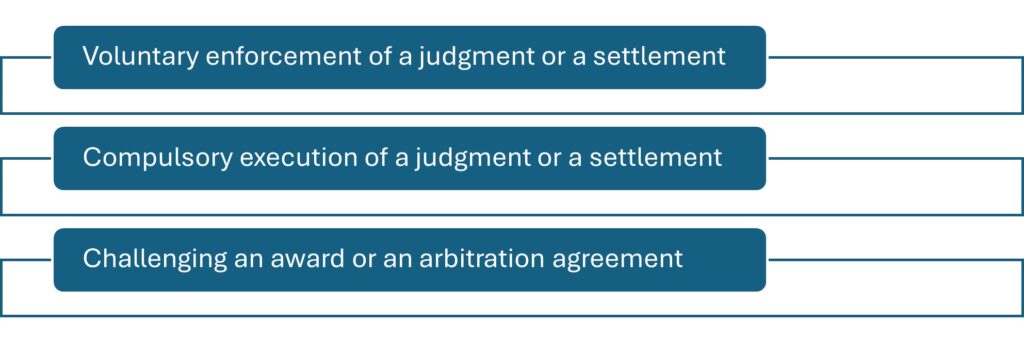
Voluntary enforcement of an award or a settlement in arbitration means that the party losing the dispute regarding a given claim behaves following the content of the arbitrators’ judgment or settlement concluded before them. It is also relevant concerning a settlement that was given in the form of a judgment.
Compulsory enforcement of a judgment or settlement in the form of a judgment is its sanctioning (approval) by the state court. The state court recognizes the judgment (when the claim established therein is not subject to enforcement) or declares enforceability (when the judgment/settlement is suitable for enforcement—in practice by a bailiff).
Challenging an arbitration award may include, an annulment, amendment, declaration of invalidity, determination that the judgment does not cause specific legal effects, etc. In Poland, it is possible to issue a claim for overturning the arbitration award by a state court.
Practical remarks
The presented scenarios are based on the Polish processual law, that is the so-called arbitration law. The statute is always of key importance (the rules of permanent arbitration courts do not generally regulate the issue of forcing the losing party to comply with the award or challenge of an arbitration award). The arbitration law regulates the cases of refusal of recognition/declaration of enforceability of an award. The statute also determines when an arbitrator’s award should be overturned by a state court.
The grounds for refusing recognition/declaration of enforceability of an award are strictly defined and concern the errors that the arbiters made in the verdict, not before issuing it.
Based on the statistics about 2% of the verdicts are overturned. Moreover, a refusal to recognize/ declare the enforceability of an award is extremely rare.
Blog created by

Practice Leader
Arbitration





